Radiopharmaceuticals 

What are Radiopharmaceuticals?

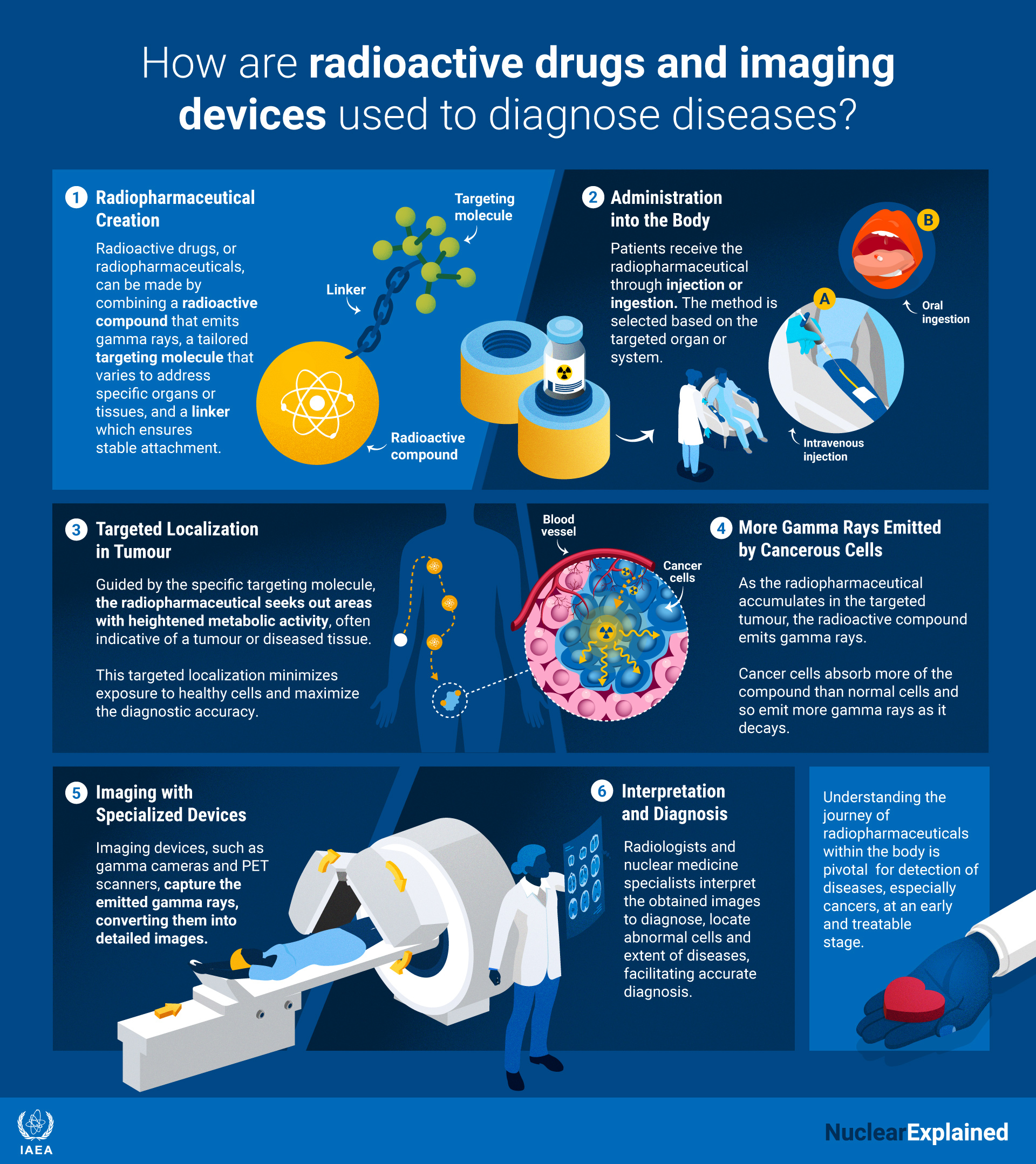
Radiopharmaceuticals are radioactive chemicals or pharmaceutic preparations, labeled with a radionuclide in tracer or therapeutic concentration. Radiopharmaceuticals are agents used to diagnose certain medical problems or treat certain diseases. They may be given to the patient in several different ways. For example, they may be given by mouth, given by injection, or placed into the eye or into the bladder.

Radiopharmaceuticals are radioisotopes bound to biological molecules able to target specific organs, tissues or cells within the human body. These radioactive drugs can be used for the diagnosis and, increasingly, for the therapy of diseases.

Tc-99m
The radioisotope most widely used in medicine is Tc-99m, employed in some 80% of all nuclear medicine procedures. It is an isotope of the artificially-produced element technetium and it has almost ideal characteristics for a nuclear medicine scan, such as with SPECT.
Once a radiopharmaceutical has stuck to a cancer cell, the radioactive compound naturally breaks down. This decay releases energy that damages the DNA of nearby cells. And when a cell’s DNA is irreparably damaged, that cell dies. Cancer cells are particularly sensitive to radiation-induced DNA damage.

Radiopharmaceuticals retract physiology, biochemistry, or pathology in the body without causing any physiological effect. They are referred to as radiotracers because they are administered in sub-pharmacological doses that “traces” a particular physiological or pathological body process.

A diagnostic radiopharmaceutical emits radiation called “(gamma) photons”. Like X rays, this special form of light can penetrate the body and detected by an external “camera” that will produce a “picture” which can be used to, for instance, see a tumour or assess the functioning of the lungs.

List of Radiopharmaceuticals


Lutathera

Lutathera